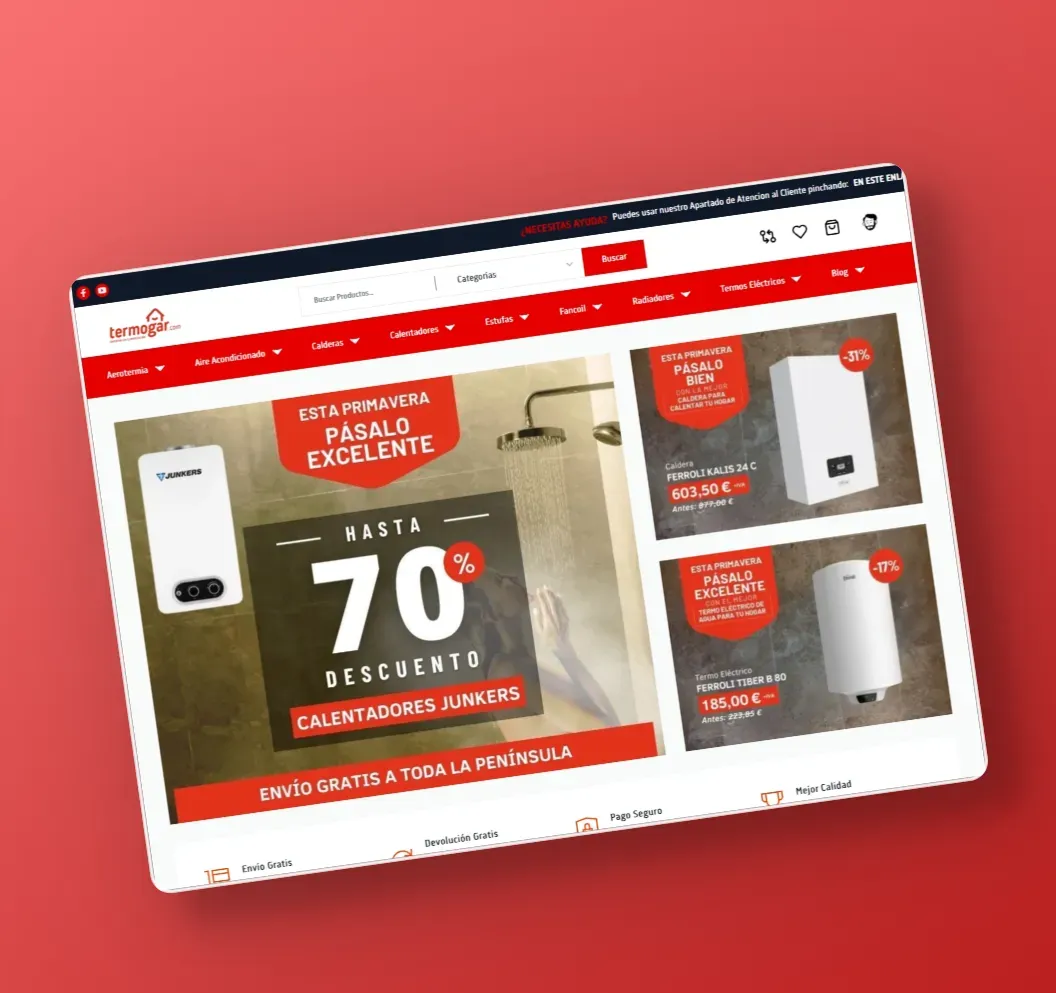
Online store for heating and biomass
E-commerce + Websites + SEO + Paid ads2024
Custom online stores, from catalog to checkout, built to sell from day one.
A store is judged at the checkout, not on the homepage. We design the catalog, the product page and the cart around the doubt a customer has before paying, and we measure every step to find out where the sale is lost.
We use the technology that fits the business: the platform your team already knows, or the own code that is needed when the catalog, the stock or the sales rules do not fit anywhere. Either way the store ends up documented and yours.
Catalog and product pages
Pages with the information a customer needs to decide and to buy.
Cart and checkout
The path to the purchase, tested and measured step by step.
Payments and shipping
Gateways, taxes and shipping rules, properly connected.
Sales analytics
What people look at, what they buy and where the cart is abandoned.
Built to measure
Custom design and development, no closed templates.
SEO from the start
Technical SEO baked in from the first line of code.
One team
One team accountable for traffic, leads and sales.
Audit and strategy
We review your site, your market and your data. We come out with a plan, a calendar and a fixed price.
Design, development and technical SEO
We design and build, with content, SEO and analytics wired in from the start.
Launch, measurement and growth
We launch, measure and improve. Every month with your business data, not with screenshots.
A store on an existing platform, with the catalog already loaded, ships between six and ten weeks. If the backend has to be built to measure it runs to three or four months. We set the date after seeing the catalog and the integrations you need.
The price depends on the catalog, the number of integrations —ERP, stock, shipping, analytics— and whether the platform is new or the one you already had. We send a fixed proposal after the audit, with the parts broken down: platform, design, development and integrations.
Both, depending on the case. Shopify works well when the catalog is standard and the team wants full autonomy. If the business needs its own rules —dynamic pricing, inventory per channel, recommendations— we work on the platform with our own code, or on a backend built to measure. We decide with the data in front of us, not out of habit.
In Spain almost everything goes through Redsys, and we integrate it with the redirect flow and the bank notifications, so an order the bank confirms gets marked as paid on its own. We also work with PayPal and Stripe when the end customer asks for them.
You do, from the panel. We connect stock to your ERP or to your supplier when needed, so the number the customer sees is the same one the warehouse sees. If the integration is not possible, manual updates stay in one place with no duplicates.